
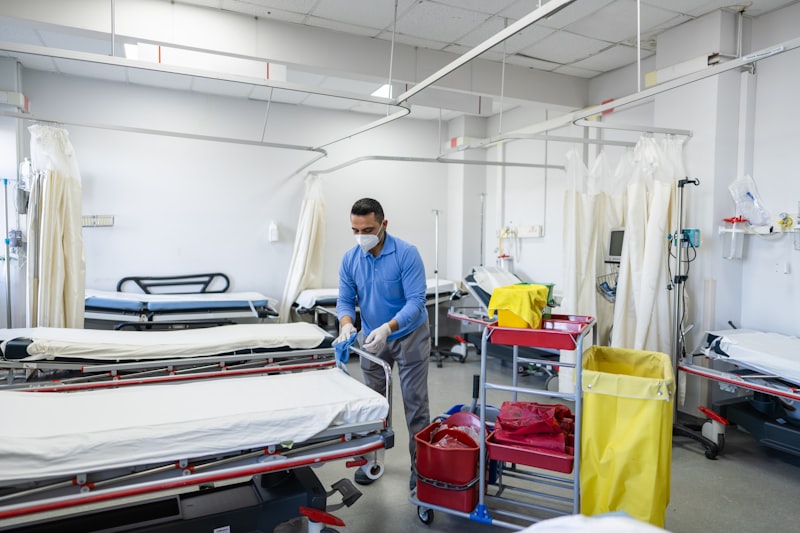
Urgent Care Center Cleaning in Medford, MA
Urgent care center cleaning built on CDC guidance, documented visit by visit, for Medford facilities. $2M insured.
What urgent care center cleaning covers in Medford
For urgent care centers in Medford, the risk we plan around is rooms turn in minutes while disinfectant contact time does not shrink to match. The surfaces that decide the outcome: high-turnover exam rooms and triage.
Facility types we clean under this service:
- Urgent Care Centers
- Walk In Clinics
- Occupational Health
Usually arranged with the site manager.
About Medford, MA
- Municipal form: City
- County: Middlesex County
- Region: Greater Boston
- Population: 59,659 (2020 U.S. Census)
- Land area: 8.1 sq mi
- Water area: 0.6 sq mi
- Density: about 7,365 residents per sq mi
- ZIP codes: 02153, 02155
- From our base: about 23 miles east of Marlborough (straight line)
- Typical healthcare setting: hospital-affiliated outpatient campus, urgent care and ambulatory surgery
Medford settings that match this service include Lawrence Memorial Hospital of Medford (outpatient and urgent care campus (no emergency department)). They are listed as market context — the kind of urgent care center our protocol is written for — not as clients.
Local health authority: Medford Health and Human Services Department (official Medford page). Healthcare facilities are licensed and surveyed by the Massachusetts Department of Public Health; the local board handles environmental-health matters under the State Sanitary Code and local rules.
Sources: U.S. Census Bureau (2020 Census; Gazetteer files), USPS ZIP codes, and our own verification of local facilities. Distances are straight-line.
Survey findings we help Medford facilities prevent
Real, published regulatory findings — every citation links to its source.
Joint Commission EC.02.06.01 EP 1 (becomes PE.01.01.01 EP 1–2 in January 2026)
Interior spaces not safe and suitable for the care provided — damaged, worn or porous surfaces, flooring and casework that can no longer be effectively cleaned.
Joint Commission EC.02.06.01 EP 20 (becomes PE.01.01.01 EP 3 in January 2026)
Environment not clean and free of odours.
Joint Commission EC.02.02.01 EP 5 (becomes PE.02.01.01 EP 4 in January 2026)
Hazardous chemical risks not minimised across selection, handling, storage and disposal — in practice the unattended housekeeping cart, unlabelled secondary containers of disinfectant, and unsecured chemical storage.
Inside a Medford service visit
Where contamination concentrates
- Triage chairs and vital-signs equipment
- Exam tables and stretchers
- Door handles and push plates
- Restroom fixtures and specimen pass-throughs
- Light switches
- Hand-sanitizer dispensers
What the crew does, in order
- Use disinfectants with contact times short enough for the room-turn pace your clinic runs.
- Change cloths between rooms, clean to dirty, and never carry restroom equipment into exam rooms.
- Empty trash; sharps and regulated waste stay with your licensed hauler.
- Damp-mop floors throughout, including under stretchers and exam tables.
- Log each room, product and time so the next shift knows what was done.
A starting schedule
- Exam rooms: patient-contact surfaces between patients during hours, full clean at end of day.
- Isolation or respiratory rooms: terminal clean after use as policy directs.
- Floors: daily, with spot cleaning of spills immediately.
Urgent care centers with long daily hours usually combine an end-of-day clean with an in-hours waiting-room and restroom service.
Documentation you receive
- Room-turn and end-of-day cleaning checklists
- Safety Data Sheets
- Signed service logs
- Certificate of insurance
Before you sign with a cleaning company
- Will you clean our waiting room during open hours, or only after close?
- How do you coordinate with our staff on isolation rooms?
- What do our logs look like at the end of each day?
We answer each of these in writing after the free assessment.
Urgent Care Cleaning in Medford — common questions
Yes. Medford (Middlesex County) is one of the 109 Massachusetts cities and towns we serve. It is about 23 miles east of our Marlborough base in a straight line. Every engagement starts with a free on-site assessment; call (978) 307-8107.
Verified examples include Lawrence Memorial Hospital of Medford (outpatient and urgent care campus (no emergency department)). We list them as local market context; they are not presented as our clients.
The Medford Health and Human Services Department; its official page is https://www.medfordma.org/departments/health-department. Clinics, hospitals and long-term care facilities are licensed and surveyed by the Massachusetts Department of Public Health, while the local board of health handles local environmental-health matters under the State Sanitary Code and local regulations. Our cleaning records are kept so they serve both.
It does not, unless the product is chosen for it. Incorrect low- and intermediate-level disinfection — wrong product for the surface, and label contact time not observed — ranked third among the Joint Commission's top five infection control observations for the Ambulatory Health Care program in 2023, cited under IC.02.02.01 EP 1. The fix is a product whose label contact time fits your real turnover, wetting the exam table, side rails, counter, door hardware and chair first so they dwell while the rest of the room is done, and re-wetting anything that dries early. We tell you the number before contract, not after a survey.
Both, and split incorrectly it fails. Exam-room turnover, restroom checks, waiting-area high-touch and spill response have to happen while patients are present — a single closing crew cannot cover a walk-in clinic that runs twelve hours. We typically place an on-site attendant during peak hours with a defined response time for spills and room releases, plus a closing crew for floors, restroom deep clean, waste, and the areas that cannot be done around patients. Room release stays with your clinical staff; we clean when a room is handed to us and signal back when it is ready.
No — it is a repair issue, and it needs to be documented as one. Joint Commission EC.02.06.01 EP 1, becoming PE.01.01.01 EP 1–2 in January 2026, requires interior spaces to be safe and suitable for the care provided; torn exam table vinyl, chipped casework, split cove base and porous or damaged flooring can no longer be effectively cleaned no matter who cleans them. We issue a dated written condition report identifying each item so your capital request has evidence behind it. Continuing to scrub a torn table just spreads contamination and gives the surveyor a second finding.
Nearby urgent care centers we clean
Free urgent care center cleaning assessment in Medford
22+ years clinical experience. $2M insured. No obligation.