
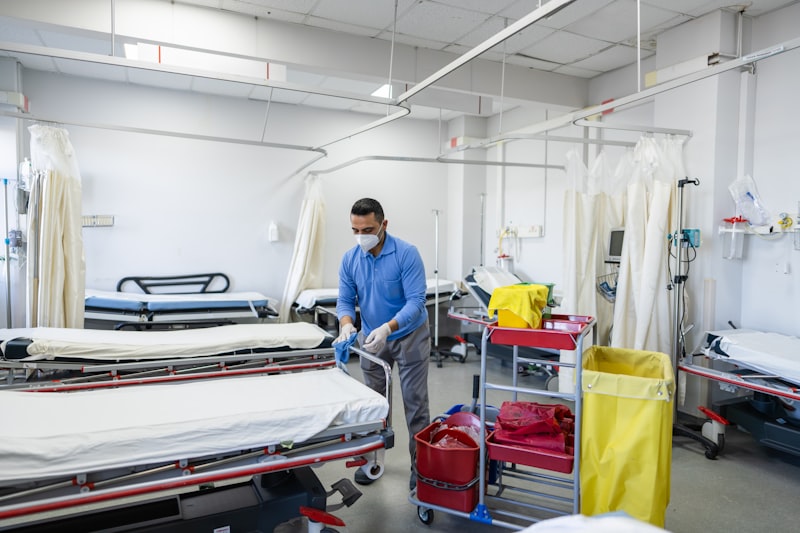
Urgent Care Center Cleaning in Massachusetts
Clinical-grade environmental services for healthcare facilities in all 109 Massachusetts cities and towns. Founded by a 22-year clinical veteran. $2M insured.
Urgent Care Center Cleaning for Massachusetts facilities
Dory's Cleaning Services provides urgent care center cleaning across Massachusetts. What we protect against: rooms turn in minutes while disinfectant contact time does not shrink to match. The zone that matters most: high-turnover exam rooms and triage.
- Urgent Care Centers
- Walk In Clinics
- Occupational Health
Survey findings we help facilities prevent
Real, published regulatory findings — every citation links to its source.
Joint Commission IC.02.01.01 EP 2, Ambulatory Health Care programme
Standard precautions not followed — hand hygiene missed after glove removal, PPE misused, and reusable PPE not reprocessed to the manufacturer's instructions because staff were never trained to clean it.
Joint Commission IC.02.02.01 EP 1
Low- and intermediate-level disinfection performed incorrectly — wrong product for the surface or device, and label contact time not observed. This is the finding that most directly implicates routine exam-room cleaning.
Joint Commission IC.02.02.01 EP 2
High-level disinfection and sterilisation of reusable instruments not performed to the manufacturer's instructions — conflicting instructions never clarified, one cycle used for devices needing different parameters, staff never assessed for competency.
Joint Commission IC.02.02.01 EP 4
Clean and sterile supplies stored improperly — under sinks, exposed to splash, on the floor, or in a way that compromises the sterile barrier.
Joint Commission EC.02.06.01 EP 1 (becomes PE.01.01.01 EP 1–2 in January 2026)
Interior spaces not safe and suitable for the care provided — damaged, worn or porous surfaces, flooring and casework that can no longer be effectively cleaned.
Joint Commission EC.02.06.01 EP 20 (becomes PE.01.01.01 EP 3 in January 2026)
Environment not clean and free of odours.
Joint Commission EC.02.02.01 EP 5 (becomes PE.02.01.01 EP 4 in January 2026)
Hazardous chemical risks not minimised across selection, handling, storage and disposal — in practice the unattended housekeeping cart, unlabelled secondary containers of disinfectant, and unsecured chemical storage.
The standards that govern this work
- OSHA Bloodborne Pathogens Standard — 29 CFR 1910.1030
- CDC Guidelines for Environmental Infection Control in Health-Care Facilities
- EPA List N registered disinfectants
Urgent Care Center Cleaning — common questions
It does not, unless the product is chosen for it. Incorrect low- and intermediate-level disinfection — wrong product for the surface, and label contact time not observed — ranked third among the Joint Commission's top five infection control observations for the Ambulatory Health Care program in 2023, cited under IC.02.02.01 EP 1. The fix is a product whose label contact time fits your real turnover, wetting the exam table, side rails, counter, door hardware and chair first so they dwell while the rest of the room is done, and re-wetting anything that dries early. We tell you the number before contract, not after a survey.
Both, and split incorrectly it fails. Exam-room turnover, restroom checks, waiting-area high-touch and spill response have to happen while patients are present — a single closing crew cannot cover a walk-in clinic that runs twelve hours. We typically place an on-site attendant during peak hours with a defined response time for spills and room releases, plus a closing crew for floors, restroom deep clean, waste, and the areas that cannot be done around patients. Room release stays with your clinical staff; we clean when a room is handed to us and signal back when it is ready.
'Environment is clean and free of odors' is its own element — Joint Commission EC.02.06.01 EP 20, becoming PE.01.01.01 EP 3 in January 2026 — and it sits among the top five Environment of Care opportunities in data covering May 2024 to May 2025. In urgent care the usual sources are the trash holding area, restroom floor grout and the base of fixtures, carpet or entry matting saturated in winter, and biohazard containers held too long. Air freshener masks and buys a worse finding. We attack sources: increased waste pickup, restroom floor scrubbing rather than mopping, matting replacement, and extraction on soft surfaces.
No — it is a repair issue, and it needs to be documented as one. Joint Commission EC.02.06.01 EP 1, becoming PE.01.01.01 EP 1–2 in January 2026, requires interior spaces to be safe and suitable for the care provided; torn exam table vinyl, chipped casework, split cove base and porous or damaged flooring can no longer be effectively cleaned no matter who cleans them. We issue a dated written condition report identifying each item so your capital request has evidence behind it. Continuing to scrub a torn table just spreads contamination and gives the surveyor a second finding.
Joint Commission EC.02.02.01 EP 5, becoming PE.02.01.01 EP 4 in January 2026, covers minimizing hazardous chemical risk across selection, handling, storage and disposal, and it is a top five Environment of Care opportunity. In practice the citation is the unattended cart, the unlabeled spray bottle of diluted disinfectant, and the unsecured closet. Our rules: no cart left unattended in a patient area, every secondary container labeled with product name and hazard information, concentrates dispensed only at the closet station, closet locked, and Safety Data Sheets on site for everything we bring. Staff are trained on the label and can state the contact time on request.
No. Joint Commission IC.02.01.01 EP 2 findings — reusable PPE not reprocessed to the manufacturer's instructions because staff were never trained to clean it — ranked first among the top five infection control observations for the Ambulatory Health Care program in 2023, and that is a clinical training gap, not a housekeeping one. Reusable face shields, otoscopes, pulse oximeters, splint equipment and anything used on a patient stay with your staff under the device manufacturer's instructions. We clean the environment those devices sit in: tables, counters, carts, chairs, floors, door hardware and waiting furniture.
It is handled under 29 CFR 1910.1030 as a bloodborne pathogen exposure risk regardless of what the fluid appears to be. Our attendant restricts the area with signage, dons PPE including eye protection, absorbs the bulk with a solidifier, bags it as regulated waste per your policy, then cleans and applies an EPA-registered disinfectant with the appropriate claim for its full label contact time before releasing the area. Soft furnishings that cannot be disinfected are removed and reported for replacement. The event is logged with time, location and product. Sharps are never handled by hand — your staff manage those.
Yes. Improperly stored clean and sterile supplies — under sinks, exposed to splash, on the floor, or with the sterile barrier compromised — ranked fifth among the top five infection control observations for the Ambulatory Health Care program in 2023 under IC.02.02.01 EP 4. Our staff will not relocate your supplies, because deciding where clinical stock belongs is your call, but we report what we see on the QA round in writing so it is on record before a surveyor finds it. We also keep our own materials off the floor and out of clinical storage for the same reason.
The contract should carry a seasonal tier written in at signing: a defined increase in high-touch frequency for waiting, triage, restrooms and check-in, added attendant hours during peak, and a stated call-out response time — priced in advance so no one is negotiating in December. For multi-site operators we hold a floating pool rather than site-locked staff, so a call-out at one clinic does not strip coverage from another. What does not change seasonally is contact time or product. Volume changes how often surfaces are treated, never how long the disinfectant is allowed to work.
Sterilization and high-level disinfection of reusable instruments is entirely yours — IC.02.02.01 EP 2, first on the Joint Commission's most frequently cited higher-risk requirements for 2023, and it requires device-specific competency no cleaning contractor should claim. Also yours: patient-contact devices, sharps, medication areas, releasing a room as clinically clear, and specimen handling. Ours: environmental surfaces, floors, restrooms, waiting and triage areas, exam-room turnover cleaning once handed over, waste transport to your holding area, and spill decontamination. We put that split in the service agreement line by line, because the gap between the two lists is where citations are born.
Urgent Care Center Cleaning across Massachusetts
Choose your city for local urgent care center cleaning details.
Free urgent care center cleaning assessment
22+ years clinical experience. $2M insured. No obligation.