
Urgent Care Center Cleaning in Sherborn, MA
Urgent care center cleaning built on CDC and OSHA practice, documented visit by visit, for Sherborn facilities. $2M insured.
Urgent Care Center Cleaning for Sherborn facilities
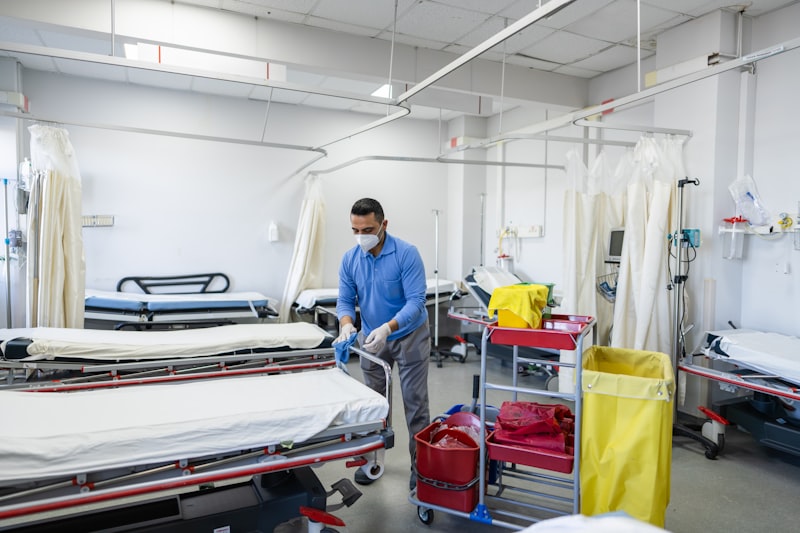
In a urgent care center, most cleaning failures happen at high-turnover exam rooms and triage. That is where our Sherborn crews start, because the underlying risk is rooms turn in minutes while disinfectant contact time does not shrink to match.
Facility types we clean under this service:
- Urgent Care Centers
- Walk In Clinics
- Occupational Health
Usually arranged with the site manager.
About Sherborn, MA
- Municipal form: Town
- County: Middlesex County
- Region: MetroWest
- Population: 4,401 (2020 U.S. Census)
- Land area: 15.8 sq mi
- Water area: 0.4 sq mi
- Density: about 279 residents per sq mi
- ZIP code: 01770
- From our base: about 12 miles southeast of Marlborough (straight line)
- Typical healthcare setting: no significant healthcare infrastructure
We have not verified a urgent care center inside Sherborn itself; the closest verified ones on our routes are in Medway (about 6 mi) and Hopkinton (about 8.6 mi). If your urgent care center is in Sherborn, call (978) 307-8107 and we will confirm scheduling for your address before the assessment.
Local health authority: Sherborn Board of Health (official Sherborn page). Healthcare facilities are licensed and surveyed by the Massachusetts Department of Public Health; the local board handles environmental-health matters under the State Sanitary Code and local rules.
Sources: U.S. Census Bureau (2020 Census; Gazetteer files), USPS ZIP codes, and our own verification of local facilities. Distances are straight-line.
Citations Sherborn urgent care centers can avoid
Real, published regulatory findings — every citation links to its source.
Joint Commission EC.02.06.01 EP 1 (becomes PE.01.01.01 EP 1–2 in January 2026)
Interior spaces not safe and suitable for the care provided — damaged, worn or porous surfaces, flooring and casework that can no longer be effectively cleaned.
Joint Commission EC.02.06.01 EP 20 (becomes PE.01.01.01 EP 3 in January 2026)
Environment not clean and free of odours.
Joint Commission EC.02.02.01 EP 5 (becomes PE.02.01.01 EP 4 in January 2026)
Hazardous chemical risks not minimised across selection, handling, storage and disposal — in practice the unattended housekeeping cart, unlabelled secondary containers of disinfectant, and unsecured chemical storage.
Inside a Sherborn service visit
The surfaces we prioritise in Sherborn
- Triage chairs and vital-signs equipment
- Exam tables and stretchers
- Rolling stools
- Pulse oximeters and blood pressure cuffs
- Registration counter and kiosk screens
- Waiting-room seating arms
What the crew does, in order
- Clean and disinfect the waiting room's shared surfaces — it holds the most undiagnosed patients.
- Change cloths between rooms, clean to dirty, and never carry restroom equipment into exam rooms.
- Empty trash; sharps and regulated waste stay with your licensed hauler.
- Damp-mop floors throughout, including under stretchers and exam tables.
- Log each room, product and time so the next shift knows what was done.
How often
- Waiting room: shared surfaces several times a day during peak hours.
- Restrooms: several times a day in busy centers.
- Floors: daily, with spot cleaning of spills immediately.
Urgent care centers with long daily hours usually combine an end-of-day clean with an in-hours waiting-room and restroom service.
Documentation you receive
- Room-turn and end-of-day cleaning checklists
- Product list with EPA registration numbers and contact times
- Bloodborne pathogen training records
- Certificate of insurance
Before you sign with a cleaning company
- Can your products meet our room-turn time without shortening contact times?
- How do you handle a room used by a patient with suspected C. difficile or norovirus?
- Will you clean our waiting room during open hours, or only after close?
We answer each of these in writing after the free assessment.
Urgent Care Cleaning in Sherborn — common questions
We have not verified one inside Sherborn. The typical healthcare setting here is no significant healthcare infrastructure. If you operate a urgent care center in town, we can schedule it on the same route as neighbouring towns.
The Sherborn Board of Health; its official page is https://www.sherbornma.org/board-health. Clinics, hospitals and long-term care facilities are licensed and surveyed by the Massachusetts Department of Public Health, while the local board of health handles local environmental-health matters under the State Sanitary Code and local regulations. Our cleaning records are kept so they serve both.
The closest served towns to Sherborn are Natick (about 3.9 mi), Millis (about 4.1 mi), Dover (about 4.2 mi). See the full list on our service areas page.
No. Joint Commission IC.02.01.01 EP 2 findings — reusable PPE not reprocessed to the manufacturer's instructions because staff were never trained to clean it — ranked first among the top five infection control observations for the Ambulatory Health Care program in 2023, and that is a clinical training gap, not a housekeeping one. Reusable face shields, otoscopes, pulse oximeters, splint equipment and anything used on a patient stay with your staff under the device manufacturer's instructions. We clean the environment those devices sit in: tables, counters, carts, chairs, floors, door hardware and waiting furniture.
The contract should carry a seasonal tier written in at signing: a defined increase in high-touch frequency for waiting, triage, restrooms and check-in, added attendant hours during peak, and a stated call-out response time — priced in advance so no one is negotiating in December. For multi-site operators we hold a floating pool rather than site-locked staff, so a call-out at one clinic does not strip coverage from another. What does not change seasonally is contact time or product. Volume changes how often surfaces are treated, never how long the disinfectant is allowed to work.
Sterilization and high-level disinfection of reusable instruments is entirely yours — IC.02.02.01 EP 2, first on the Joint Commission's most frequently cited higher-risk requirements for 2023, and it requires device-specific competency no cleaning contractor should claim. Also yours: patient-contact devices, sharps, medication areas, releasing a room as clinically clear, and specimen handling. Ours: environmental surfaces, floors, restrooms, waiting and triage areas, exam-room turnover cleaning once handed over, waste transport to your holding area, and spill decontamination. We put that split in the service agreement line by line, because the gap between the two lists is where citations are born.
Nearby urgent care centers we clean
Free urgent care center cleaning assessment in Sherborn
22+ years clinical experience. $2M insured. No obligation.