
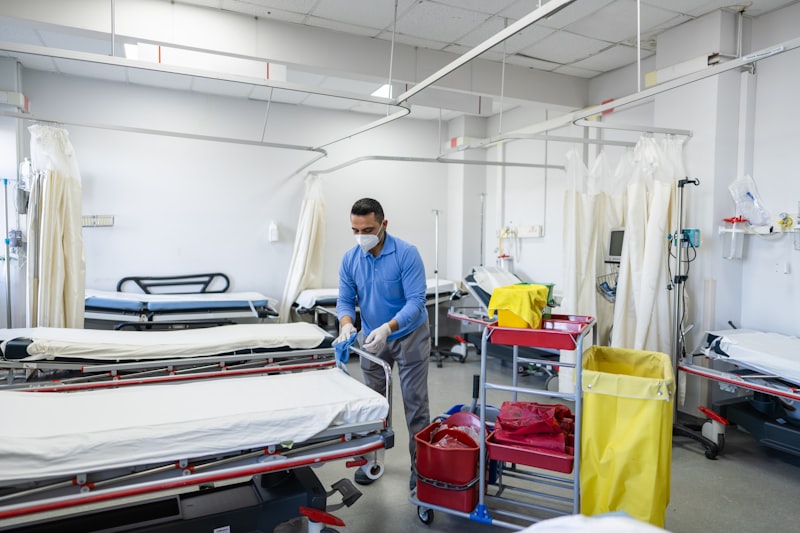
Urgent Care Center Cleaning in Braintree, MA
Urgent care center cleaning built on CDC guidance, documented visit by visit, for Braintree facilities. $2M insured.
Braintree urgent care centers: how we clean
In an urgent care center, most cleaning failures happen at high-turnover exam rooms and triage. That is where our Braintree crews start, because the underlying risk is rooms turn in minutes while disinfectant contact time does not shrink to match.
Facility types we clean under this service:
- Urgent Care Centers
- Walk In Clinics
- Occupational Health
Usually arranged with the site manager.
About Braintree, MA
- Municipal form: City
- County: Norfolk County
- Region: South Shore
- Population: 39,143 (2020 U.S. Census)
- Land area: 13.8 sq mi
- Water area: 0.8 sq mi
- Density: about 2,846 residents per sq mi
- ZIP codes: 02184, 02185
- From our base: about 30 miles east of Marlborough (straight line)
- Typical healthcare setting: rehabilitation hospital and large multi-specialty outpatient offices
Braintree settings that match this service include South Shore Health Health Express Braintree (urgent care with on-site x-ray and lab). They are listed as market context — the kind of urgent care center our protocol is written for — not as clients.
Local health authority: Braintree Health Division (official Braintree page). Healthcare facilities are licensed and surveyed by the Massachusetts Department of Public Health; the local board handles environmental-health matters under the State Sanitary Code and local rules.
Sources: U.S. Census Bureau (2020 Census; Gazetteer files), USPS ZIP codes, and our own verification of local facilities. Distances are straight-line.
How we clean urgent care centers in Braintree
Where contamination concentrates
- Triage chairs and vital-signs equipment
- Exam tables and stretchers
- Rolling stools
- Pulse oximeters and blood pressure cuffs
- X-ray positioning surfaces
- Keyboards and workstation-on-wheels handles
Our sequence, step by step
- Agree how rooms are turned between patients and what staff disinfect during hours.
- Change cloths between rooms, clean to dirty, and never carry restroom equipment into exam rooms.
- Empty trash; sharps and regulated waste stay with your licensed hauler.
- Damp-mop floors throughout, including under stretchers and exam tables.
- Log each room, product and time so the next shift knows what was done.
How often
- Exam rooms: patient-contact surfaces between patients during hours, full clean at end of day.
- Isolation or respiratory rooms: terminal clean after use as policy directs.
- Floors: daily, with spot cleaning of spills immediately.
Centers open seven days need weekend coverage planned in advance.
Documentation you receive
- Product list with EPA registration numbers and contact times
- Safety Data Sheets
- Signed service logs
- Certificate of insurance
Survey findings we help Braintree facilities prevent
Real, published regulatory findings — every citation links to its source.
Joint Commission IC.02.01.01 EP 2, Ambulatory Health Care programme
Standard precautions not followed — hand hygiene missed after glove removal, PPE misused, and reusable PPE not reprocessed to the manufacturer's instructions because staff were never trained to clean it.
Joint Commission IC.02.02.01 EP 1
Low- and intermediate-level disinfection performed incorrectly — wrong product for the surface or device, and label contact time not observed. This is the finding that most directly implicates routine exam-room cleaning.
Joint Commission IC.02.02.01 EP 4
Clean and sterile supplies stored improperly — under sinks, exposed to splash, on the floor, or in a way that compromises the sterile barrier.
Questions worth asking at the walkthrough
- Will you clean our waiting room during open hours, or only after close?
- How do you coordinate with our staff on isolation rooms?
- What do our logs look like at the end of each day?
We answer each of these in writing after the free assessment.
Urgent Care Cleaning in Braintree — common questions
Verified examples include South Shore Health Health Express Braintree (urgent care with on-site x-ray and lab). We list them as local market context; they are not presented as our clients.
The Braintree Health Division; its official page is https://braintreema.gov/217/Health-Division. Clinics, hospitals and long-term care facilities are licensed and surveyed by the Massachusetts Department of Public Health, while the local board of health handles local environmental-health matters under the State Sanitary Code and local regulations. Our cleaning records are kept so they serve both.
The closest served towns to Braintree are Weymouth (about 2.9 mi), Randolph (about 3.3 mi), Quincy (about 3.8 mi). See the full list on our service areas page.
Joint Commission EC.02.02.01 EP 5, becoming PE.02.01.01 EP 4 in January 2026, covers minimizing hazardous chemical risk across selection, handling, storage and disposal, and it is a top five Environment of Care opportunity. In practice the citation is the unattended cart, the unlabeled spray bottle of diluted disinfectant, and the unsecured closet. Our rules: no cart left unattended in a patient area, every secondary container labeled with product name and hazard information, concentrates dispensed only at the closet station, closet locked, and Safety Data Sheets on site for everything we bring. Staff are trained on the label and can state the contact time on request.
No. Joint Commission IC.02.01.01 EP 2 findings — reusable PPE not reprocessed to the manufacturer's instructions because staff were never trained to clean it — ranked first among the top five infection control observations for the Ambulatory Health Care program in 2023, and that is a clinical training gap, not a housekeeping one. Reusable face shields, otoscopes, pulse oximeters, splint equipment and anything used on a patient stay with your staff under the device manufacturer's instructions. We clean the environment those devices sit in: tables, counters, carts, chairs, floors, door hardware and waiting furniture.
It is handled under 29 CFR 1910.1030 as a bloodborne pathogen exposure risk regardless of what the fluid appears to be. Our attendant restricts the area with signage, dons PPE including eye protection, absorbs the bulk with a solidifier, bags it as regulated waste per your policy, then cleans and applies an EPA-registered disinfectant with the appropriate claim for its full label contact time before releasing the area. Soft furnishings that cannot be disinfected are removed and reported for replacement. The event is logged with time, location and product. Sharps are never handled by hand — your staff manage those.
Nearby urgent care centers we clean
Free urgent care center cleaning assessment in Braintree
22+ years clinical experience. $2M insured. No obligation.