
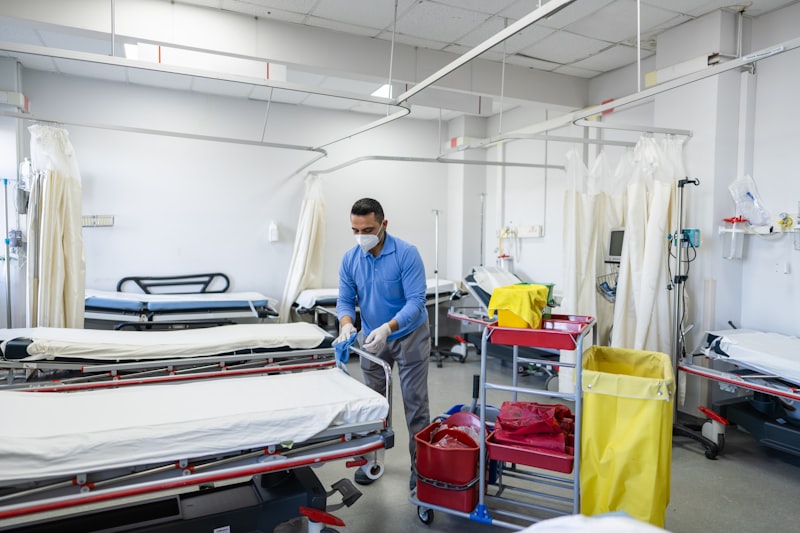
Urgent Care Center Cleaning in Canton, MA
Clinical-grade cleaning for urgent care centers in Canton and across Norfolk County. Founded by a 22-year clinical veteran. $2M insured.
Canton urgent care centers: how we clean
In an urgent care center, most cleaning failures happen at high-turnover exam rooms and triage. That is where our Canton crews start, because the underlying risk is rooms turn in minutes while disinfectant contact time does not shrink to match.
Facility types we clean under this service:
- Urgent Care Centers
- Walk In Clinics
- Occupational Health
Usually arranged with the site manager.
Canton: the local picture
- Municipal form: Town
- County: Norfolk County
- Region: South Shore
- Population: 24,370 (2020 U.S. Census)
- Land area: 18.7 sq mi
- Water area: 0.8 sq mi
- Density: about 1,301 residents per sq mi
- ZIP code: 02021
- From our base: about 25 miles southeast of Marlborough (straight line)
- Typical healthcare setting: primary care offices
Canton is on our regular routes, together with Braintree (about 6.6 mi) and Quincy (about 8.4 mi), where urgent care centers like yours operate. If you run an urgent care center in Canton, call (978) 307-8107 and we will book the walkthrough for your address.
Local health authority: Canton Board of Health (official Canton page). Healthcare facilities are licensed and surveyed by the Massachusetts Department of Public Health; the local board handles environmental-health matters under the State Sanitary Code and local rules.
Sources: U.S. Census Bureau (2020 Census; Gazetteer files), USPS ZIP codes, and our own verification of local facilities. Distances are straight-line.
Survey findings we help Canton facilities prevent
Real, published regulatory findings — every citation links to its source.
Joint Commission IC.02.01.01 EP 2, Ambulatory Health Care programme
Standard precautions not followed — hand hygiene missed after glove removal, PPE misused, and reusable PPE not reprocessed to the manufacturer's instructions because staff were never trained to clean it.
Joint Commission IC.02.02.01 EP 2
High-level disinfection and sterilisation of reusable instruments not performed to the manufacturer's instructions — conflicting instructions never clarified, one cycle used for devices needing different parameters, staff never assessed for competency.
Joint Commission IC.02.02.01 EP 4
Clean and sterile supplies stored improperly — under sinks, exposed to splash, on the floor, or in a way that compromises the sterile barrier.
Urgent Care Cleaning in Canton: the working detail
Where contamination concentrates
- Registration counter and kiosk screens
- Waiting-room seating arms
- Door handles and push plates
- Restroom fixtures and specimen pass-throughs
- Light switches
- Hand-sanitizer dispensers
How a visit runs
- Agree how rooms are turned between patients and what staff disinfect during hours.
- Use disinfectants with contact times short enough for the room-turn pace your clinic runs.
- Terminal-clean rooms used for patients with suspected contact-transmitted or respiratory infections as your policy requires.
- Clean and disinfect the waiting room's shared surfaces — it holds the most undiagnosed patients.
- Log each room, product and time so the next shift knows what was done.
Frequency, area by area
- Exam rooms: patient-contact surfaces between patients during hours, full clean at end of day.
- Waiting room: shared surfaces several times a day during peak hours.
- Restrooms: several times a day in busy centers.
Urgent care centers with long daily hours usually combine an end-of-day clean with an in-hours waiting-room and restroom service.
Records for your surveyors
- Room-turn and end-of-day cleaning checklists
- Product list with EPA registration numbers and contact times
- Safety Data Sheets
- Signed service logs
Questions worth asking at the walkthrough
- Can your products meet our room-turn time without shortening contact times?
- How do you handle a room used by a patient with suspected C. difficile or norovirus?
- What do our logs look like at the end of each day?
We answer each of these in writing after the free assessment.
Urgent Care Cleaning in Canton — common questions
Yes. Canton (Norfolk County) is one of the 109 Massachusetts cities and towns we serve. It is about 25 miles southeast of our Marlborough base in a straight line. Every engagement starts with a free on-site assessment; call (978) 307-8107.
The typical healthcare setting here is primary care offices. Canton is on our regular routes, so if you operate an urgent care center in town we can schedule it alongside the neighboring towns we already serve.
The Canton Board of Health; its official page is https://www.town.canton.ma.us/139/Board-of-Health. Clinics, hospitals and long-term care facilities are licensed and surveyed by the Massachusetts Department of Public Health, while the local board of health handles local environmental-health matters under the State Sanitary Code and local regulations. Our cleaning records are kept so they serve both.
It is handled under 29 CFR 1910.1030 as a bloodborne pathogen exposure risk regardless of what the fluid appears to be. Our attendant restricts the area with signage, dons PPE including eye protection, absorbs the bulk with a solidifier, bags it as regulated waste per your policy, then cleans and applies an EPA-registered disinfectant with the appropriate claim for its full label contact time before releasing the area. Soft furnishings that cannot be disinfected are removed and reported for replacement. The event is logged with time, location and product. Sharps are never handled by hand — your staff manage those.
Yes. Improperly stored clean and sterile supplies — under sinks, exposed to splash, on the floor, or with the sterile barrier compromised — ranked fifth among the top five infection control observations for the Ambulatory Health Care program in 2023 under IC.02.02.01 EP 4. Our staff will not relocate your supplies, because deciding where clinical stock belongs is your call, but we report what we see on the QA round in writing so it is on record before a surveyor finds it. We also keep our own materials off the floor and out of clinical storage for the same reason.
Sterilization and high-level disinfection of reusable instruments is entirely yours — IC.02.02.01 EP 2, first on the Joint Commission's most frequently cited higher-risk requirements for 2023, and it requires device-specific competency no cleaning contractor should claim. Also yours: patient-contact devices, sharps, medication areas, releasing a room as clinically clear, and specimen handling. Ours: environmental surfaces, floors, restrooms, waiting and triage areas, exam-room turnover cleaning once handed over, waste transport to your holding area, and spill decontamination. We put that split in the service agreement line by line, because the gap between the two lists is where citations are born.
Free urgent care center cleaning assessment in Canton
22+ years clinical experience. $2M insured. No obligation.